
The practical answer
Choose 18-inch depth when it supports the items you own and preserves a valuable aisle. Choose 24-inch depth when larger bins need it and the garage can spare the additional six inches.
Start with your bins: use the tote fit calculator, then check the rack’s outside depth with the vehicle clearance calculator. Compare the exact-model examples below only after both checks; the shallower rack is not useful if your bins cannot sit fully supported.
On narrow screens, scroll the table sideways. Manufacturer facts are distinguished from our planning guidance below.
| Choice or check | When it helps | Watch for |
|---|---|---|
| 18-inch shelf | Smaller items along a narrow aisle | Large totes may not fit fully |
| 24-inch shelf | Bins requiring more supported depth | Six extra inches per side |
| Mixed depths | Different jobs on rear and side walls | Avoid corner interference |
Product examples to check against your measurements
These research examples illustrate the choices in this guide; they are not a tested ranking or a complete market survey. Dimensions and model details come from the linked manufacturer or retailer. Fit and cost checks are our planning guidance. Check the exact model manual before buying.
| Example and source | Fit or limitation to verify | What to include in the cost |
|---|---|---|
| Gladiator 77-inch rack with 24-inch shelves View source details ↗ | Candidate for wide bins; confirm clear opening between uprights and supported deck depth. Exterior width alone does not prove two-bin fit. | Compare usable shelf levels, delivery and required anchoring; buy bins only after checking lid dimensions. |
| Gladiator 48-inch EZ Connect, five 18-inch shelves View source details ↗ | Manufacturer-listed exterior: 48 W × 72 H × 18 D inches; five laminate shelves. Useful shallow-rack candidate, but an 18-inch deck cannot fully support the 20.625-inch short side of the example Sterilite tote. Check clear openings separately. | Compare cost per usable shelf and per bin that actually fits. This narrower rack and the 77-inch rack differ in width, shelf count and construction as well as depth. |
Compare total cost at the same storage target
Price enough shallow units to hold the same inventory as the deep option. Then compare their combined wall length and the access space each leaves. A lower rack price is not a saving if it requires a second unit or forces the vehicle outside.
Work through a two-tote fit example · Check storage beside the vehicle · Compare the two Gladiator rack configurations
The six-inch difference can be the deciding one
Shelf depth is floor space committed along the whole rack. Over a six-foot run, increasing depth from 18 to 24 inches adds three square feet of footprint. On both sides of the garage it reduces the remaining width by a full foot. These are geometric differences, not estimates of storage performance.
Compare the depths at the place you actually park. If the car door would strike either option, a shallower rack has not necessarily solved the problem. Moving the rack to the rear wall may be more effective than choosing the smaller of two poor fits.
Large totes need a two-dimensional check
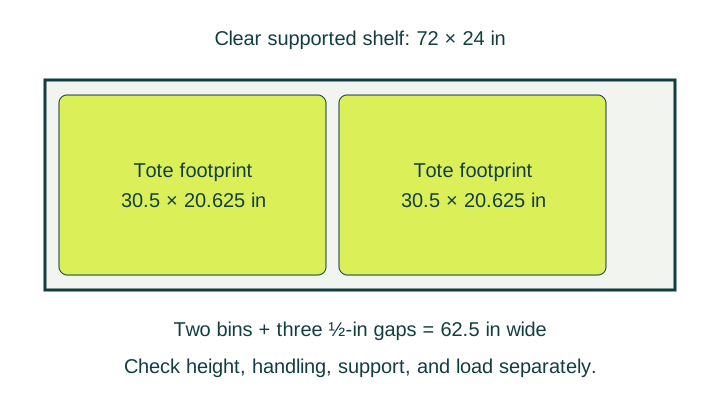
Check the bin with its lid attached and orient it on paper. Sterilite’s 1466 tote is listed at 30.5 × 20.625 × 15.25 inches outside. Neither horizontal dimension fits fully within an 18-inch supported depth; the shorter dimension is a candidate for a 24-inch deck. That does not establish compatibility with any particular rack.
Do not rotate a tote in a width calculation without also rotating the depth. The shelf-and-tote tool checks both uniform orientations. Use the clear deck dimensions rather than the rack’s outside frame dimensions, and allow enough handling room to remove a full bin.
Shallow shelves can be easier to use for small items
A deep shelf may encourage a second row of small containers that hides the first. If you repeatedly unload the front row to reach something at the back, the nominal extra capacity is costing access. Shallow bins, labels, or a different arrangement may solve more than another shelf.
For mixed storage, assign a deeper rear bay to large totes and a shallower side bay to small supplies. Matching appearance is less important than matching each zone to its contents. Keep commonly retrieved items near the front and avoid unsupported overhang.
Compare real rack candidates fairly
Compare racks of the same outside width and shelf count when you want to isolate depth. The same-family examples below make that comparison clearer; the existing broader shortlist remains useful for choosing other rack formats.
Use a simple purchase decision
First reject depths that cannot support your largest intended item. Next reject footprints that block normal vehicle or household access. Among the remaining options, compare the number of usable levels and the total installed cost, including compatible liners or accessories.
If neither depth works, change the storage format or location rather than letting a bin project into the aisle. One narrower rack that works is a better purchase than a larger unit that forces the vehicle outside.
When six inches changes the purchase
Illustrative layout: with a 120-inch inside garage width and an 84-inch vehicle envelope, an 18-inch storage run leaves 18 inches across the remaining width; a 24-inch run leaves 12. Neither number promises a usable door opening, and neither is a recommended access clearance. They show why a deeper shelf can cost more usable space than its price suggests. Use your own mirror width and practice getting out before choosing the shelf.
If your bins need a supported depth greater than 18 inches, the shallower option fails even if its footprint is attractive. A mixed-depth layout can put deep bins beyond the vehicle door zone and shallow supplies beside it. Check turning and walking routes as well as the parked position.
Hold width constant before crediting extra depth
The two 48-inch EZ Connect models above isolate depth more closely than comparing an 18-inch rack against a 77-inch-wide heavy-duty rack. The wider rack also changes how many bins fit across and how much wall length is occupied. Treat those as separate purchasing decisions.
For the 30.5-by-20.625-inch tote already discussed, a nominal 24-inch deck is a depth candidate, but a 48-inch exterior width cannot accommodate two 30.5-inch sides across. Rotating the bins makes their required depth 30.5 inches. Do not infer that every 24-inch-deep rack holds two of these totes per level.
Calculate the footprint you actually give up
For a 48-inch-wide rack, the extra 6 inches of depth consumes 288 square inches, or 2 square feet. Over a 72-inch run the difference is 3 square feet. The more important check is where that strip lies: beside a passenger door, along an access route or in unused rear-wall space.
Measure your stored items before selecting the deeper option. If small supplies occupy only the front row, extra depth can create hidden storage rather than more useful capacity.
A closer comparison: same rack family and outside width
| Exact Gladiator model | Published outside dimensions | What this comparison establishes |
|---|---|---|
| GARK485TGG: five 18-inch shelves | 48 W × 72 H × 18 D inches | Shallower footprint; clear deck still needs verification |
| GARK485XGG: five 24-inch shelves | 48 W × 72 H × 24 D inches | Six more inches of depth at the same outside width and height |
Additional manufacturer documentation checked September 29, 2026. No hands-on testing is claimed.
Continue the fit check
Common questions
Can a 27-gallon tote sit on an 18-inch shelf?
Capacity in gallons does not establish footprint. Measure the actual tote and follow the shelf maker’s support requirements. The example tote in this article is deeper than 18 inches in either orientation.
Does a liner increase a shelf’s rating?
Do not assume so. A liner can support small items across openings, but only the manufacturer can approve its effect on the rated shelf configuration.
Should both side walls use the same shelf depth?
Only if both sides serve the same storage and access needs. A mixed layout can preserve the frequently used door side while placing larger bins elsewhere.
How to use this comparison
We compare documented fit, access, compatibility, and installation requirements. We have not tested these products. There is no performance score or universal winner. Follow the source links to confirm the exact model, current manual, included components, and total cost before buying.
Check the exact product before ordering
Confirm the selected model, current manual, included parts, delivered price and return terms. A listing is a candidate to investigate, not a guarantee that it fits your garage.
These are ordinary manufacturer links. No affiliate commissions are currently enabled. Read our affiliate disclosure.
Sources & product details
Manufacturer information checked September 17, 2026. Specifications and availability may change; verify the exact model and manual.