
The practical answer
For the documented Sterilite 1466 tote (30.5 × 20.625 × 15.25 inches), start with a nominal 24-inch-deep rack: an 18-inch supported deck is too shallow in either orientation. Two totes need 61 inches of clear width before handling gaps when the 20.625-inch side runs front to back. Check actual supported deck depth—not the outside frame—and leave room to lift and retrieve each bin. Other 27-gallon totes can differ.
Before selecting a rack, use the tote-fit calculator with your measured openings and handling gaps. Compare 18- versus 24-inch shelf depth if the rack sits beside the car, then follow the garage measurement guide to record the parking and retrieval space.
On narrow screens, scroll the table sideways. Manufacturer facts are distinguished from our planning guidance below.
| Approach | Best suited to | Check before buying |
|---|---|---|
| Wide 24-inch-deep shelving | Mixed bins and other storage | Clear width, supported depth, shelf height |
| Individual tote rails | Frequent access to matching totes | Exact rim compatibility and loaded-bin limits |
| Stacking on the floor | A few rarely accessed bins | Stacking instructions and access to the bottom bin |
Product examples to check against your measurements
These research examples illustrate the choices in this guide; they are not a tested ranking or a complete market survey. Dimensions and model details come from the linked manufacturer or retailer. Fit and cost checks are our planning guidance. Check the exact model manual before buying.
| Example and source | Fit or limitation to verify | What to include in the cost |
|---|---|---|
| Gladiator 77-inch rack with 24-inch shelves View source details ↗ | Candidate for wide bins; confirm clear opening between uprights and supported deck depth. Exterior width alone does not prove two-bin fit. | Compare usable shelf levels, delivery and required anchoring; buy bins only after checking lid dimensions. |
| Sterilite 27-gallon Industrial Tote View source details ↗ | Use the actual lid dimensions from this exact tote, not a generic 27-gallon assumption. It is a fit reference, not a reason to replace usable bins. | Include bins in the total only if needed; verify single-bin versus multipack pricing. |
Compare cost per supported tote position
Divide the delivered rack and required installation cost by the number of your loaded totes that fit and remain retrievable. Do not count nominal shelf positions blocked by an upright or too low for the lid. Reusing bins can be cheaper than replacing them to suit a rack.
Compare 18- and 24-inch shelf depth · Calculate shelf and tote fit · Check Gladiator rack differences
There is no universal 27-gallon footprint
Gallon capacity describes volume, not a standard outside size. Lids, handles, tapered walls, and different product families change the footprint. Measure the widest point with the lid attached. Do not use the smaller dimensions at the bottom of the bin to decide whether it will pass between shelf uprights.
For example, Sterilite lists its 1466 Industrial Tote at 30.5 × 20.625 × 15.25 inches outside. That is a useful worked example, not a substitute for measuring your own bins.
Work through the orientation
Place the 30.5-inch dimension across the shelf and the 20.625-inch dimension into the shelf depth. Two bins would need at least 61 inches of clear width before adding handling gaps. Rotating the bins would require more than 30.5 inches of supported depth, so an ordinary 24-inch rack would not fully support that orientation.
This explains why dividing the advertised shelf width by the narrow side of the tote can give a misleading capacity. Both dimensions must work at the same time. The tote-fit calculator evaluates both uniform orientations and reports the larger grid that fits.
A real rack worth checking
The Gladiator 77-inch Heavy Duty Rack is a research candidate for large totes: the manufacturer lists four shelves and outside dimensions of 77 × 24 × 72 inches. Its wide format is potentially useful for a rear wall, but we have not measured its clear shelf openings or tested it with these totes.
Do not treat the outside 77-inch width as a promise of a particular bin count. Confirm the usable deck and upright spacing, along with vertical shelf adjustments. The trade-off is floor depth: this rack takes a nominal two feet from the garage before any aisle space.
Open shelves versus individual tote rails
Open shelving is flexible when your household mixes bins, toolboxes, and loose items. A rail system can make individual totes accessible without lifting a stack, but its compatibility may depend on the shape and strength of the tote’s rim. Do not assume all yellow-lid totes share the same rim geometry.
For a DIY rail rack, use a plan intended for the exact tote and verify the load path, fasteners, and mounting. Our calculator estimates space only; it cannot validate a wood design or approve suspending a bin by its rim.
Before you press order
Measure your largest tote, choose an orientation, add a handling gap, and check the real supported shelf dimensions. Weigh a representative loaded tote and multiply by the intended count per level. Compare that load with the manual’s applicable limit and distribute it as directed.
If possible, try a single tote on the assembled rack before buying matching bins for the entire garage. A bin that fits tightly but cannot be gripped and removed with the car parked is not a successful fit.
A complete fit calculation
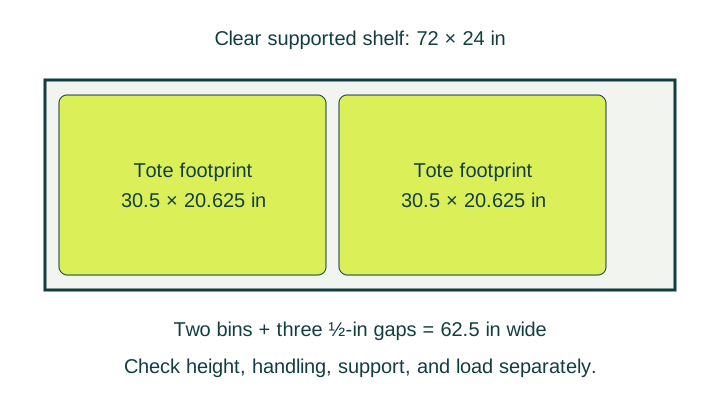
Using a hypothetical 72-inch clear width and 24-inch supported depth, two 30.5 by 20.625-inch totes fit in one row. With a half-inch gap at both ends and between totes, the required width is 62.5 inches. Depth needs 21.625 inches including front and rear gaps.
If the clear height is 18 inches, a 15.25-inch tote plus a one-inch lifting allowance uses 16.25 inches. Four identical usable levels would hold eight totes geometrically. At an assumed 35 pounds each that is 70 pounds per shelf and 280 pounds total. These are example inputs, not a verified rack configuration: check both applicable load limits and actual handling.
Choose the shelf around the lid and the next retrieval
Open shelving is the most flexible starting point when your tote brands or sizes vary. Measure the largest lid, not the narrower base, and confirm the deck supports the whole base. Reject a deeper shelf if the extra depth blocks the car door you use every morning.
Rim-supported rails solve a different problem: compatibility with the exact tote rim matters more than gallon capacity. Buy a small, returnable trial only after checking the approved tote models and installation instructions. Do not assume two 27-gallon bins have interchangeable rims.
Test the hardest shelf, not just the easiest one
Check the narrowest opening between uprights and the usable height above each deck. Braces, beam lips and shelf clips can make one level less usable than another. Put the fullest tote at the proposed retrieval height and check that the lid and handles clear the frame without tipping the load toward you. A count of eight geometrically fitting totes is not a recommendation to lift eight equally heavy totes to every height.
Assign frequently used contents to comfortable retrieval heights and keep heavier loads low, within the exact rack instructions. Label the outward-facing side so finding one item does not require pulling every bin off the rack.
Compare cost per usable tote position
Divide the delivered system cost by the number of positions that actually pass your fit and access checks. Include required decking, anchors and any replacement bins; do not count a top shelf you cannot sensibly reach. For illustration only, a $240 complete setup with eight usable positions is $30 per position; a $210 setup with six is $35. These are arithmetic examples, not current product prices.
If depth is what prevents parking, the cheaper answer may be smaller bins on shallower shelves rather than a deeper rack for existing totes. Compare the cost of changing bins against the daily cost in usable garage space.
Choose orientation by support and retrieval, not bin count alone
Planning comparisons below are research-based. Worked dimensions are illustrative unless identified as manufacturer specifications; they do not establish installation approval.
| Decision | What to compare | What can change the answer |
|---|---|---|
| 30.5-inch side across the shelf | At least 20.625 inches of supported depth before allowances | Two bins need 61 inches plus handling gaps |
| 20.625-inch side across the shelf | At least 30.5 inches of supported depth before allowances | A 24-inch shelf fails full-footprint support in this orientation |
| Nominal 18-inch-deep shelf | Measure the actual supported deck | This example tote is too deep in either orientation without overhang |
| Mixed tote brands | Measure every lid, handle and base footprint | Gallon labels cannot establish identical fit |
Continue your plan: Compare 18- and 24-inch shelf depth · Compare Gladiator rack formats · Run both tote orientations.
Common questions
Why can’t I count three totes across a 77-inch rack?
Turning a tote may reduce its width across the rack but increase required depth beyond the deck. Both dimensions and the clear opening must pass together.
Can I turn a 27-gallon tote sideways on an 18-inch shelf?
For the 30.5 by 20.625-inch example used here, neither orientation fits entirely within an 18-inch supported depth. Measure your own tote and follow the rack instructions; rotation alone does not remove the depth constraint.
Will a 48-inch-wide, 24-inch-deep shelf hold two of these 27-gallon totes?
Not two Sterilite 1466 totes flat in one row. Their 30.5-inch sides need 61 inches across before gaps. Rotating both reduces that width to 41.25 inches but requires 30.5 inches of supported depth. Check the clear opening rather than the outside rack width; this dimensional example does not describe every 27-gallon tote.
How much space should I leave above a tote?
Use tote height plus the lifting movement needed to clear the shelf lip and get a secure grip. For the 15.25-inch-high example tote, a chosen 1-inch lifting allowance requires 16.25 inches of unobstructed opening. That allowance is illustrative, not a universal minimum. Measure to the lowest beam or obstruction above the tote, and rehearse retrieval; shelf adjustment pitch is not the same as clear opening height.
How to use this comparison
We compare documented fit, access, compatibility, and installation requirements. We have not tested these products. There is no performance score or universal winner. Follow the source links to confirm the exact model, current manual, included components, and total cost before buying.
Check the exact product before ordering
Confirm the selected model, current manual, included parts, delivered price and return terms. A listing is a candidate to investigate, not a guarantee that it fits your garage.
These are ordinary manufacturer links. The separate Amazon link in the product table is a paid link. Read our affiliate disclosure.
Sources & product details
Manufacturer information checked September 17, 2026. Specifications and availability may change; verify the exact model and manual.