
The practical answer
Start with one shallow storage wall and a clear access side. Add rear-wall storage only after checking vehicle length, door travel, and the route into the house.
Ready to choose one storage zone? Check shelf depth beside the car, folding versus rolling workbenches, or overhead clearance if floor space is already committed.
On narrow screens, scroll the table sideways. Manufacturer facts are distinguished from our planning guidance below.
| Choice or check | When it helps | Watch for |
|---|---|---|
| One shallow side wall | Narrow room with daily parking | Door and mirror clearance |
| Deeper rear storage | Spare length beyond vehicle | House entrance and liftgate |
| Seasonal overhead zone | Infrequent retrieval | Door travel, mounting and ladder access |
Build the plan around the tightest dimension
A narrow garage rarely needs the same storage on both sides. Assign the side used for getting in and out of the car as an access zone. Put shallow, frequently used storage on the opposite side where practical. Use the rear wall for deeper bins only if the vehicle can stop far enough from it while leaving the garage door clear.
Measure the inside room at its narrowest points. Steps and door casings can matter more than the full wall-to-wall measurement. Sketch them as occupied areas, not as details to remember after the shelves arrive. If the entrance is at a rear corner, preserve that route first.
A worked example: 12 feet wide by 22 feet deep
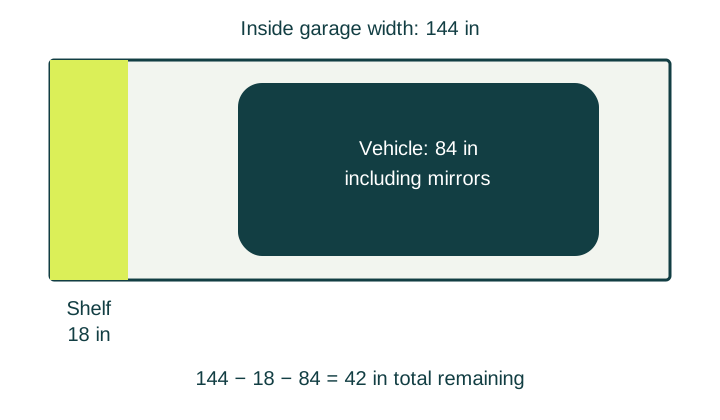
This is a hypothetical rectangle, not a standard garage or a photographed installation. A 144-inch inside width minus an 84-inch vehicle including mirrors leaves 60 inches total. Adding an 18-inch-deep shelf on one side leaves 42 inches to distribute between the two sides. Adding a matching shelf opposite leaves only 24 inches total. Neither calculation tells you how widely a door will open.
At 264 inches deep, a 190-inch vehicle and a 24-inch rear rack leave 50 inches of combined front-and-rear space. A step, hitch, open liftgate, or projecting cabinet handle could consume part of it. Use the vehicle-clearance calculator to compare versions, then mark the preferred position with tape.
Choose a zone that can function with the car parked
Trash bins, school bags, and a frequently used bike should not all depend on the same narrow corner. Rehearse retrieving each one individually, including turning around with it. A shelf that can be reached sideways might work for a bottle of cleaner but not for a large tote held in two hands.
Accept occasional car movement for seasonal storage if that fits your routine. Do not make moving the car a prerequisite for every ordinary task. The point is to distinguish deliberate compromises from conflicts you discover after installation.
Use height without making retrieval harder
Moving an object off the floor does not automatically recover its full footprint. A vertical bike still projects from the wall, and a hanging garden tool may swing or have a wide handle. Draw the stored object as well as its mounting hardware. Keep heavy, frequently handled items at a position you can manage.
Overhead storage is a separate structural and clearance decision. It may be useful for occasional items, but should not become the default answer to a garage that is too narrow for a comfortable vehicle exit.
Buy in stages and test the nightly reset
Install the first useful zone, load it with the actual belongings, and park normally for several days. Notice what lands on the floor and what is too inconvenient to return. Revise before buying a second matching unit.
A workable end-of-day routine should not require unloading shelves or folding away an unfinished project. Leave a small, identified temporary landing place for deliveries and things leaving the house. Once that fills, clear it rather than extending it into the parking bay.
Common questions
Can I use both side walls?
Yes, if the measured storage, vehicle, and usable door gaps fit together. Two shallow walls may work; two deep walls can remove most of the usable access space.
Is there a minimum garage width that always works?
No single number accounts for vehicle width, door movement, mobility needs, and storage. Use actual measurements and a physical access test.