
The practical answer
Check the full moving-door envelope, the lowest installed rack point, and the height available for loading. Structural suitability and safe retrieval remain separate decisions.
Map the moving door first
A closed garage door does not show the space it uses while opening. Observe the complete travel and record the tracks, opener rail, springs, and highest moving sections. Keep people and objects out of the door’s path while checking. Follow the door and rack manufacturers’ required clearances.
A rack can appear to fit above the hood and still interfere with the door or opener. Draw the proposed rectangle on your plan and identify every obstruction within and beside it. If the conflict cannot be resolved within the instructions, choose a different location or storage format.
Calculate the bottom of the rack
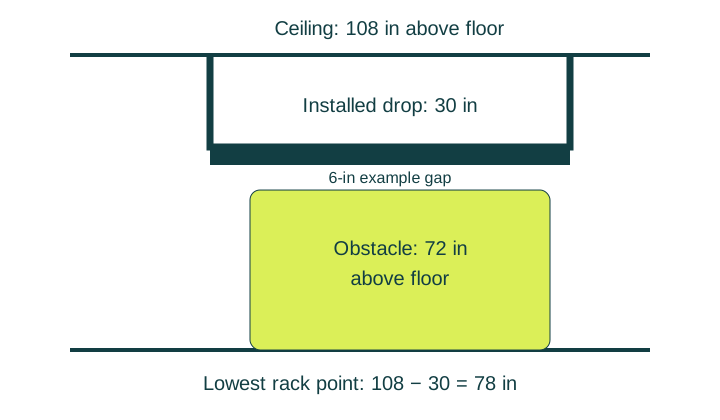
Subtract the installed dropdown from ceiling height to estimate the bottom of the rack. Confirm where the manufacturer measures that dropdown; the frame, decking, and accessories may extend lower than the storage surface. Compare the lowest point with the highest obstacle underneath.
For a 108-inch ceiling and a 30-inch installed drop, the calculated underside is 78 inches above the floor. An obstacle 74 inches high leaves only four inches before your chosen margin. This arithmetic is a screening check, not a statement that four inches is safe or sufficient.
Include real vehicle use
Measure the vehicle with the equipment that stays on it, such as roof rails or a carrier. Consider whether an open liftgate would enter the proposed rack area. The tallest point when parked may not be the highest point during normal use.
Also think about how you will remove a bin. A ceiling rack above the vehicle can work for seasonal storage, but retrieving it may require moving the car and positioning a ladder. Avoid putting daily-use items where access becomes an awkward overhead lift.
Treat structural suitability as a separate decision
A rack’s advertised load is not a load rating for your ceiling. Joist material, spacing, span, condition, attachment, and installation details matter. Read the exact model’s manual before buying; do not assume all engineered framing or ceiling types are supported.
When the structure is unknown or the required installation is outside your experience, have an appropriately qualified professional assess it. Do not change garage-door springs, tracks, or structural members to make a storage rack fit.
Choose the load and access plan
Use overhead space for manageable, infrequently accessed items. Follow the rated working load, distribution rules, and accessory limits for your exact rack. Test or breaking loads are not working loads. Heavy items are often better kept on lower storage where handling is easier.
Our overhead-clearance calculator checks the geometry you enter. It does not approve the mounting, ladder access, fire-protection clearance, door operation, or structural capacity. Finish those checks before installation.
Record two independent vertical checks
On your sketch, write one calculation for the space below the lowest rack point and another for the usable height above its deck. Do not substitute advertised dropdown for internal storage height. A rack that clears the car can still leave too little room to lift the intended tote onto the shelf.
Repeat the below-rack check for every obstacle that can enter its footprint: vehicle roof accessories, an open liftgate, and the moving door envelope. Our calculator takes one highest obstacle value, so your measurement must represent the controlling case. A static vehicle height alone may omit that case.
A positive clearance number can still describe an unusable rack
In an illustrative 108-inch-high garage, a 30-inch drop leaves the lowest rack point at 78 inches. A 74-inch obstacle leaves 4 inches before any chosen margin. That arithmetic does not check an open hatch or the moving garage door; either may be the controlling obstacle. Enter the highest relevant point within the footprint, then check the full movement separately.
Nor does a 30-inch drop promise 30 inches of usable storage height. Deck thickness, beams, ceiling obstructions and the path used to slide a tote into place all matter. Keep underside clearance and top-side loading clearance as separate measurements.
Request a scoped installation quote
Give the installer the exact rack model, selected drop range, intended contents, proposed footprint and known ceiling construction. Ask whether the quote includes locating suitable framing, all required hardware, assembly, attachment, cleanup and any site-specific work. A kit price alone cannot establish an installed price.
Do not choose a large rack before confirming where it can be attached. If the appropriate attachment locations shift the rack into the garage-door path or prevent retrieval, a smaller footprint or another storage format may be the better outcome.
Separate underside clearance from storage height
Planning comparisons below are research-based. Worked dimensions are illustrative unless identified as manufacturer specifications; they do not establish installation approval.
| Decision | What to compare | What can change the answer |
|---|---|---|
| Below the rack | Ceiling height minus drop to lowest installed point | Vehicle, hatch, garage-door movement and hanging accessories |
| Above the deck | Actual unobstructed space from deck surface upward | Tote height plus room to lift and slide it |
| At the loading edge | Space for the person and item during retrieval | Ladder or other suitable access position, with car moved if needed |
| At the ceiling | Permitted bracket locations and framing | Exact manual and building-specific mounting suitability |
Continue your plan: Compare exact rack configurations · Evaluate a low ceiling · Screen underside clearance.
Common questions
Can the calculator approve storage above a garage door?
No. It only subtracts the entered dimensions. Door travel, installation instructions, and structural suitability must be checked separately.
Can hanging hooks use the spare clearance below the rack?
Include the hook and its loaded item in the lowest installed point and obstacle check. Confirm the exact accessory is permitted and how its load counts toward the rack rating. Empty-hook clearance is not loaded-item clearance.