
The practical answer
A shallow rack can solve one clearance problem while creating another: too little height for the items on it. Check both the clearance below the rack and usable loading space inside it.
On narrow screens, scroll the table sideways. Manufacturer facts are distinguished from our planning guidance below.
| Choice or check | When it helps | Watch for |
|---|---|---|
| Shallow dropdown variant | Limited underside clearance | Totes may be too tall to load |
| Deeper rack away from door | A genuinely clear ceiling zone | Vehicle hatch and access route |
| Wall or floor storage | No workable ceiling envelope | Lost side or rear floor depth |
Use the lowest relevant ceiling height
Measure where the rack would actually go. Beams, soffits, opener hardware, and a sloping ceiling can make a room’s headline height misleading. Record the height above the finished floor and identify any obstacle that enters the proposed platform footprint.
The open garage door is only one position in its travel. Do not assume an area is free because the fully open door sits below or beside it. Observe the full movement from a safe position and compare it with the door and rack instructions.
Work the underside calculation first
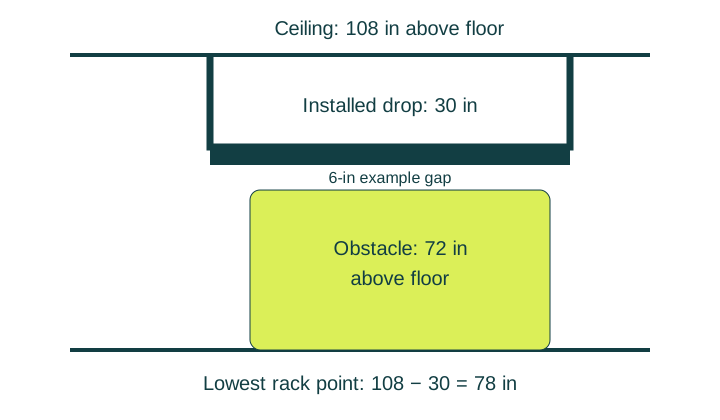
A hypothetical 96-inch ceiling with a rack extending down 24 inches puts its lowest point at 72 inches. If the relevant vehicle or moving-door obstacle reaches 70 inches, only two inches remain before any required margin. That is a warning to investigate, not approval to install.
A 12-inch drop in the same arithmetic leaves an underside at 84 inches, but may not give enough usable space above the deck for tall bins. Manufacturer dropdown descriptions may refer to a different measurement point, so confirm whether the frame, decking, or accessories extend below it.
Then check the actual storage height
Usable internal height is not necessarily the dropdown. Deck thickness, braces, and the route used to slide a bin into place can reduce usable space. Measure the item with its lid, handles, and any protrusion, then allow room for the required lifting motion.
Do not assume a tote will fit simply because it is shorter than the rack drop. An item that can be wedged into a cavity may still be impossible to retrieve with two hands or without scraping the ceiling.
Shortlist exact variants
The linked SafeRacks 4 × 8 page offers a 12–24-inch dropdown selection separately from its deeper selection. The linked FLEXIMOUNTS GR48 Classic lists 22–40 inches. Those ranges make them different geometric candidates for a low ceiling; they are not interchangeable just because both are called 4 × 8 racks.
Our brand comparison covers the published differences. We have not installed either unit. Read the exact manual and confirm framing suitability before using a shallow-range listing as the basis for a purchase.
Know when another location is better
If every ceiling location conflicts with the door, vehicle, or loading path, consider a wall shelf or floor-supported rack in another zone. Low ceilings do not require overhead storage. A shallow side-wall system may provide less nominal volume but much easier retrieval.
Do not alter a garage door, springs, structure, or safety equipment to create space for a rack. Where the structure or required clearances are uncertain, get qualified advice. The calculator screens your geometry; it does not resolve those unknowns.
Common questions
Is an eight-foot ceiling automatically too low?
No; fit depends on the selected rack, contents, door motion, and obstacles. The example shows why ceiling height alone cannot answer the question.
Can I shorten a rack beyond its adjustment range?
Do not modify the rack outside manufacturer instructions to make it fit. Choose an approved configuration or a different storage approach.
Sources & product details
Manufacturer information checked September 17, 2026. Specifications and availability may change; verify the exact model and manual.