
The practical answer
A containment mat collects water in a defined area for removal. Open tiles let water pass through to the floor below. Choose a maintenance plan for the water, not only a surface appearance.
On narrow screens, scroll the table sideways. Manufacturer facts are distinguished from our planning guidance below.
| Choice or check | When it helps | Watch for |
|---|---|---|
| Containment mat | Localized water collection | Regular removal and edge transitions |
| Open interlocking tile | Modular surface with openings | Water remains beneath on the slab |
| Solid tile or coating | Different finished-surface goals | Follow system-specific moisture and prep rules |
Product examples to check against your measurements
These research examples illustrate the choices in this guide; they are not a tested ranking or a complete market survey. Dimensions and model details come from the linked manufacturer or retailer. Fit and cost checks are our planning guidance. Check the exact model manual before buying.
| Example and source | Fit or limitation to verify | What to include in the cost |
|---|---|---|
| RaceDeck Free-Flow View source details ↗ | An open-grid tile example. Liquid passing below the tile still needs a drying and cleaning plan. Confirm edge, perimeter and expansion details. | Quote tiles + edge pieces + cut waste + delivery. Do not use this name for a visually similar retailer tile. |
| AutoFloorGuard Mid-Size, AFG7918 View source details ↗ | Manufacturer lists 7 ft 6 in × 18 ft with a built-in containment edge. Confirm interior usable area and vehicle drip coverage. The listing showed backorder messaging; do not assume immediate availability. | Observed September 23, 2026: $189.99 sale price on the manufacturer page, before applicable tax. This is a dated reference, not a current offer; confirm delivered cost and stock. |
A vehicle zone and a whole floor have different budgets
The AFG7918 listing provides a roughly $200 product-only reference at the dated price above. Whole-floor tiles require an area-based quote plus edges, cuts and delivery. For an illustrative 20 × 20-foot rectangle, the starting area is 400 square feet, not a recommended order quantity. Price the cut layout before adding a waste allowance.
Compare mats, tiles and coatings · Measure the garage before buying · Compare current AutoFloorGuard and TruContain formats
Follow the water before choosing a product
Observe where water from the vehicle lands and where it moves on the existing slab. A floor covering does not change the underlying slope or create a drain. Record door thresholds, low spots, and the path people use from the car to the house.
If water arrives from a building leak or persistent moisture rather than ordinary vehicle drips, investigate that source before covering it. Neither an attractive tile pattern nor a containment edge proves the underlying problem has been addressed.
A containment mat creates a cleanup task
Measure the wet area around the vehicle, not just the tire tracks. Compare the usable interior area of the mat with the car and the drip pattern. Edges can take up space and create a transition for people or rolling cabinets. Follow the product’s instructions for placement and vehicle use.
Decide how you will remove the collected water before ordering. Consider the route for equipment, where the water will be disposed of appropriately, and how the mat can dry. A mat can contain a mess but also concentrate it in a place that still needs attention.
Open tiles do not make the water disappear
RaceDeck describes its Free-Flow tiles as an open design that allows drainage through the surface. That describes the tile, not the drainage of your building. Water beneath the tiles still follows the slab and must be managed according to the installed system and floor conditions.
The manufacturer’s moisture guidance should be read with the product instructions. We have not tested drying performance in your garage. Avoid transferring a claim about one ventilated system to every interlocking floor product.
Compare cleaning access and loads
Ask how to lift or clean sections, remove debris, and inspect the slab. Check what the manufacturer permits under jacks, stands, heavy cabinets, and other concentrated loads. A floor suitable for tires may have additional instructions for equipment with small contact points.
For mats, check resistance and compatibility for the conditions specified by the maker; do not assume a generic plastic sheet is equivalent to a parking mat. For either format, follow care guidance for chemicals and cleaning tools.
Choose by the actual problem
Consider a containment mat when your main need is a removable wet parking zone and you can maintain it. Consider a documented tile system when you want broader coverage and accept the cleaning routine beneath or between the tiles. If the primary goal is a permanent coated finish, assess slab suitability separately.
Before buying, mock up edges and transitions with the vehicle parked. Make sure doors, wheels, and walking routes remain usable. This is a format comparison, not a traction test or a claim that one surface is safe under every winter condition.
Select by the mess you need to manage
Choose a containment mat to investigate when the immediate need is collecting water and grit under the vehicle. Measure tire paths, the parked footprint, the mat’s usable containment area and the space needed to remove or empty it. A raised edge may affect a walking route. Inspect the surface below during the cleaning routine.
Choose interlocking tiles to investigate when a larger modular floor surface is the objective. Open tiles allow debris and liquid to pass below; that is not removal of the liquid from the garage. Solid tiles have seams and are not automatically a waterproof containment system. Check the exact product’s cleaning, expansion and vehicle-use instructions.
Compare lifetime chores as well as purchase area
For tiles, quote edge ramps, waste from cuts, perimeter details and replacement pieces as well as the measured square footage. For a mat, include a practical place to clean and dry it. Neither format repairs an underlying slab moisture problem. Before buying, check whether you can lift or move the chosen product for inspection and cleaning without emptying the entire garage.
An SUV label does not establish mat fit
Use the actual vehicle and parking position to mark the intended wet area. Include expected runoff from the ends and sides and the variation in where the vehicle stops. The mirror-to-mirror width used for parking clearance is not the same as a drip footprint, and tire spacing alone does not describe it either.
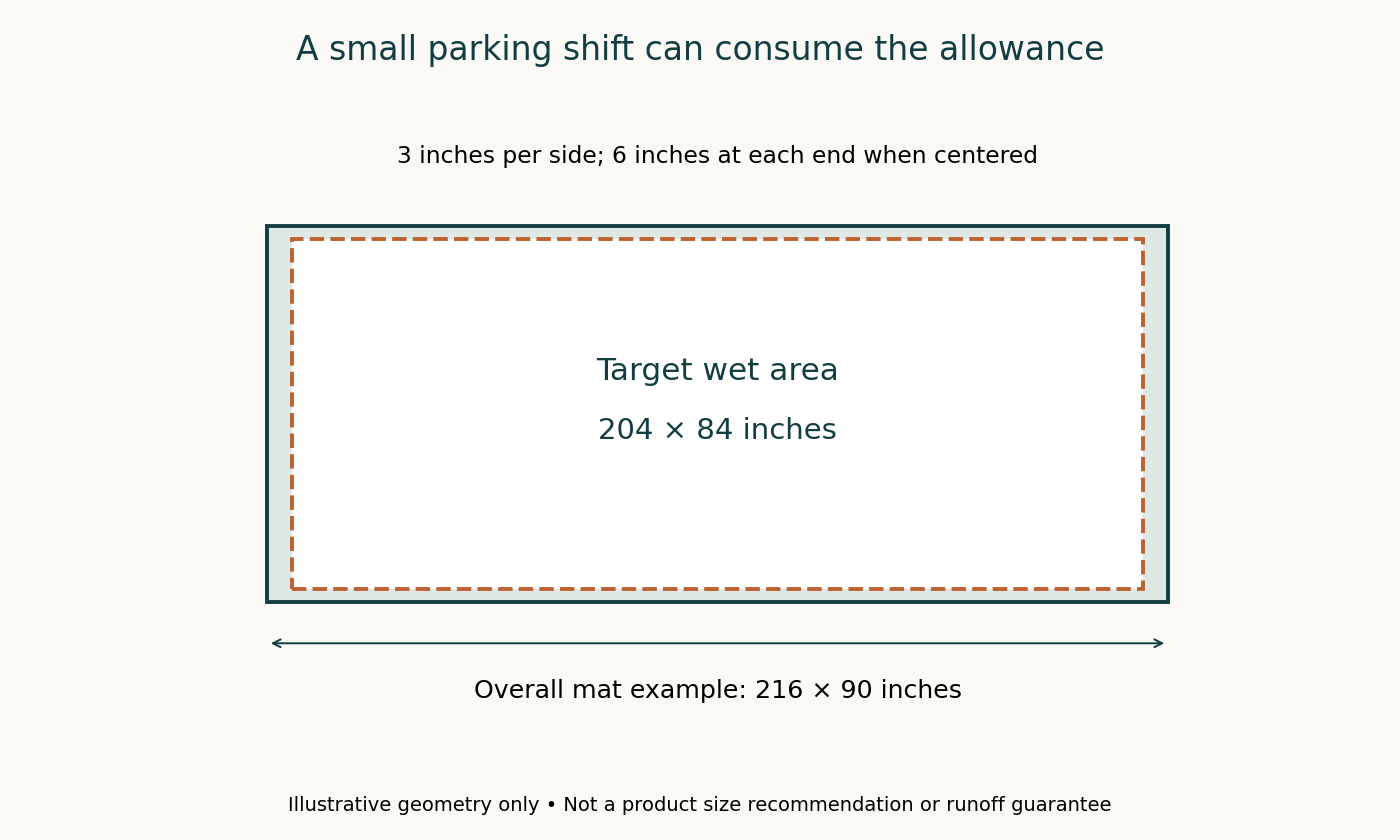
Illustration only: an 84-by-204-inch target wet area centered on a 90-by-216-inch mat leaves 3 inches at each side and 6 at each end. A 4-inch sideways shift would exceed the nominal side allowance. These numbers explain positioning sensitivity; they are not a recommended margin or a promise of captured runoff.
Measure usable collection area separately from overall size
On a raised-edge mat, ask whether dimensions include the border and how much usable area remains inside it. On an absorbent edgeless mat, do not assume a borderless design creates a watertight basin. The current AutoFloorGuard and TruContain products discussed in our dedicated comparison have different water-management approaches; older descriptions may refer to a different generation.
Tape both the outside boundary and the intended collection boundary before ordering. Check the garage door can operate, the mat lies as its instructions require and the walking route remains practical. If coverage only works with perfect parking, choose a different size or layout.
Build the maintenance decision into the purchase
A floor system succeeds only if its cleanup routine is realistic in your garage. Ask where collected water goes, how wet material dries, whether the vehicle must move and what happens underneath the product. Follow the exact product cleaning and drying instructions; do not assume tiles or a mat repair an existing moisture problem.
For cost comparison, include edge pieces and cutting waste for tiles where required, versus the correct mat size and any specified cleanup accessories. We do not have a verified installed-price range for your floor condition, so compare complete current baskets rather than invented national averages.
Size the managed area, not just the vehicle class
Planning comparisons below are research-based. Worked dimensions are illustrative unless identified as manufacturer specifications; they do not establish installation approval.
| Decision | What to compare | What can change the answer |
|---|---|---|
| Containment or absorbent parking mat | Actual parked drip footprint plus positioning allowance | Confirm whether the model retains liquid or absorbs it |
| Interlocking tiles | Chosen floor coverage, perimeter cuts and required expansion details | Confirm drainage, surface and substrate requirements |
| Walking route | Space outside the parked vehicle and mat edge | Avoid placing an edge where occupants must regularly step |
| Cleanup route | Reach to wet areas with the vehicle parked or moved | Plan how water or saturated material will be removed |
Continue your plan: Compare current mat designs · Compare all three flooring formats · Record the vehicle and door envelope.
Common questions
Do open tiles drain water out of the garage?
They may let water pass through the tile surface, but do not create a drain or change slab slope.
Can I leave collected water all winter?
Do not assume that is appropriate. Follow product care instructions and plan regular cleanup and inspection.
Can a containment mat substitute for correcting water entering the garage?
No. Choose a mat for its stated parking-area purpose. Water entering through the building or persistent moisture under a covering needs its own assessment and remedy.
How to use this comparison
We compare documented fit, access, compatibility, and installation requirements. We have not tested these products. There is no performance score or universal winner. Follow the source links to confirm the exact model, current manual, included components, and total cost before buying.
Sources & product details
Manufacturer information checked September 17, 2026. Specifications and availability may change; verify the exact model and manual.